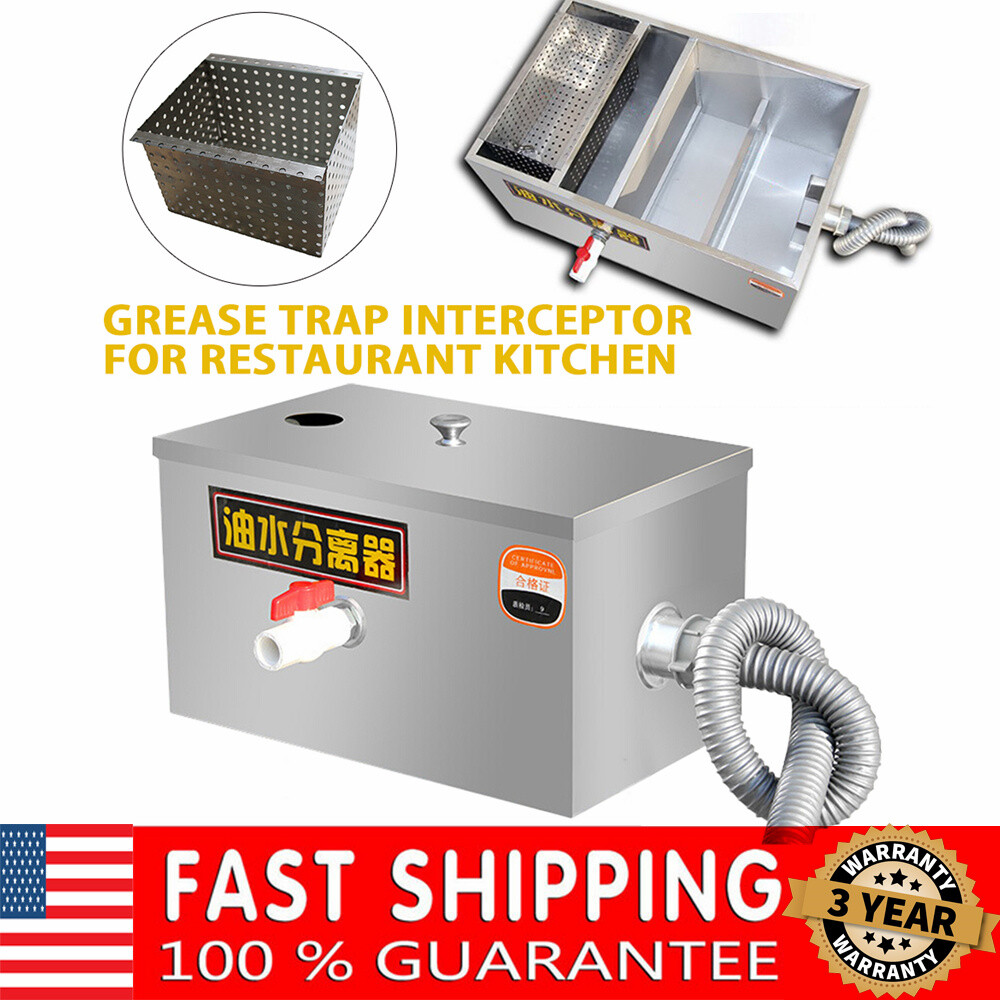
Quick verdict
Grease doesn't wait politely for a drain clog. It cools, congeals, and sticks to the inside of commercial sink lines, which is why an under-sink grease interceptor exists in the first place. Both of the listings here target that exact job: they are 18-20L stainless steel interceptors with the same overall dimensions (35*25*23 cm), the same 4.8 cm wastewater inlet diameter, and the same 2.2 cm grease outlet diameter. Their listed prices are USD 49.03 and USD 49.02, so the price gap is a single cent. With specs that close, the real difference is in the story each listing tells.
The two listings at a glance
| Listing | Listed price | Capacity | What the listing leads with |
| First stainless under-sink listing | USD 49.03 | 18-20L | Four stages of filtration and an automatic shut-off device |
| Second stainless under-sink listing | USD 49.02 | 18-20L | Package includes 1 interceptor, 1 drainage pipe, 1 lid, and installation accessories |
On paper, these two are close enough that the listed price and capacity should not be the deciding factor. The first listing spends its description on how the grease and water separation happens. The second listing spends its description on what comes in the order. That difference in focus is what separates the two.
Where each listing wins
- The first listing wins if you want a fuller description of the grease-separation process.
- The second listing wins if you want a fuller description of what is included.
Commercial Grease Interceptor - first listing
This listing gives you a description that focuses on how the grease trap does its job. It points to four stages of filtration and an automatic shut-off device for open-air placement. If you are trying to avoid a unit that lets oil and water move through without enough separation, the four-stage detail is the kind of information that helps you feel more comfortable. The limitation is on the packaging side: the listing does not spell out which components are included. You get a clear picture of the unit's performance, but you do not get the same explicit box-content breakdown that the second listing provides.
Commercial Grease Interceptor - second listing
This listing leads with the physical contents: 1 grease trap interceptor, 1 drainage pipe, 1 lid, and all accessories required for installation. That is a concrete answer to the question every buyer has about a grease interceptor: what actually shows up? The description also includes the specification details for the unit. What it does not do is spend much time on the internal separation process or the automatic shut-off behavior highlighted in the first listing. So this is the listing to choose when you care less about reading about the mechanism and more about knowing exactly what you are ordering.
Final choice by use case
The decision comes down to which description answers the question you care about. Choose the first listing if you want the operating behavior of the grease trap explained before you buy. Choose the second listing if you want the components named before you buy. The shared capacity and dimensions are already aligned, so neither listing pulls ahead on size or price. The separation happens in the details each description chooses to share, so pick the one that puts the details you need where you can see them.